
What Do Students Learn in Grade 4 Math?
Math for fourth graders includes the curriculum focal points recommended by the National Council of Teachers of Mathematics and uses the connections to the focal point to achieve an emphasis on real world problem solving. The math strands covered are number sense and operations, algebra, geometry and spatial sense, measurement and data analysis and probability. The goal in fourth grade is to have the students make the leap from arithmetic to solving problems with real world implications by using the skills they have acquired in their math lessons.
Grade 4 students should increase their place value knowledge of numbers to the millions and know their decimals to two decimal places. They should be able to compare and arrange from smallest to largest or vice versa. As the numbers become larger, the concept of rounding becomes more valuable. Students are taught rounding for estimation purposes which they will use their whole lives; one example would involve a trip to the grocery store with a limited amount of cash. Fourth graders may still use manipulatives to further their understanding of math concepts, especially as they expand their knowledge to include the base 5 system or base 8. They also work on expanded notation, writing and interpreting the expanded forms of numbers.
The math rules the student has learned to this point are reiterated and students are expected to know them by rote and understand them thoroughly. The numbers used in fourth grade multiplication, division, addition and subtraction are large, and doing those computations are easier if the basics like the multiplication tables and properties of "0" and "1" are automatic thoughts and not calculations. Word problems become more complex; adding operations and using more advanced language and terminology.
|
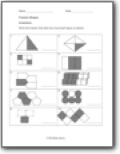
Working with fractions and decimals will help students improve their number sense. Comparing fractions to each other and to decimals and whole numbers is facilitated by the use of diagrams, number lines and manipulatives. The use of fractions and decimals introduces the numbers between whole numbers. The monetary system is used as an excellent way to study decimal places to the hundredths. Negative numbers are introduced in some fourth grade math classes.
Geometry and measurement work together to bring math alive for the fourth grader. Students study angles, lines, curves, figures and shapes to help them understand the world around them. Through geometry, they learn that math is more than figuring out answers to addition problems or division. They learn the area of their yard and how long it might take them to cut it with a lawnmower. They can then decide whether to charge by the lawn or by the hour when they start their own business in the next few years. The fourth graders' vocabularies increase with more advanced geometry. The students learn what faces and edges of polygons are and what congruency and symmetry mean and they learn how to construct polygons and then measure the area and perimeter. They learn about tessellations and the rotations and reflections found within.
Coordinate graphs or grids are used to locate and plot ordered pairs of whole numbers. This is a further introduction into algebra. These graphs also develop map reading skills and help with understanding other navigational systems, such as GPS.
Measurement skills are honed, students learn what tool is appropriate for what is being measured and when asked to measure an everyday object know whether to pick up a ruler or a yardstick. Students learn the freezing point in Celsius and Fahrenheit and the boiling point, too. They learn to convert larger measures to smaller, turning yards to inches.
All of these new and expanded skills work together to allow a fourth grader to interpret and display data and use statistics and probabilities to solve real world problems. They have started to move from limiting themselves to the classroom to seeing broader uses for what they have learned.