
What Do Students Learn in Grade 3 Math?
Third graders have acquired a wide range of skills in their previous classrooms and are ready to build on the foundations they have laid. They work to deepen their understanding of the basics and add more complex multiplication and division. They practice estimating, measuring and the description of 2 and 3 dimensional figures. They work on problem solving and venture into probabilities and mathematical reasoning.
Now that they have mastered the numbers to 1000, third grade math can take them to 10,000 or even 100,000. They learn more about the extended forms of numbers and place values. Rounding up and rounding down are used to improve knowledge of place values, as is expanded notation. Roman numerals are introduced and the students compare them with the decimal system.
Multiplication tables are memorized up to the number 10. Students learn the commutative and distributive properties of multiplication and demonstrate competency by modeling, or drawing the figures, and skip counting. They learn how to do division problems and are taught about the inverse relationship with multiplication and how they can check their work by doing the inverse computation. The special properties of "0" and "1" in multiplication and division are memorized and can be demonstrated. Word problems with more than one type of computation are introduced.
|
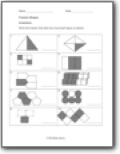
Fractions are modeled, compared and ordered. Third graders are taught about how fractions can represent all of a whole or more than one or less than the whole. They use and understand the number line in regard to fractions and can show equivalencies using real world examples such as pizza, tiles or football fields. They can add, subtract, multiply and divide fractions using common denominators or numerators. They have an understanding of decimals and know that fractions and decimals are different ways to represent the same idea. Students can translate a word problem into symbols and can solve the problem. Third graders are introduced to converting simple units into symbolic form.
In measurement and geometry, third graders are introduced to new vocabulary and concepts including right angles, perimeter, area and volume. They learn to strategize to use already learned concepts along with these new ones to solve problems. The students learn to estimate perimeter and volume using American and metric units of measure and classroom tools. Children learn types of triangles by learning the properties of angles and can identify and classify polygons by their attributes. They learn the differences between squares, rectangles and parallelograms and can describe them by their properties. Students recognize volume as a characteristic of three-dimensional objects and can describe cones, spheres, pyramids and more. Time and temperature as measurements and math are taken to the next level, the Celsius scale is introduced and a.m. and p.m. can be differentiated.
When considering the math strands of statistics, probability and data analysis, third graders can use reasonable estimates and probability experiments to predict future results.
They use bar graphs, experimentation and past records to predict future outcomes. The students summarize and organize the data and the results and can use different methods to display them. Third graders use mathematical reasoning to analyze problems, discard unnecessary information, prioritize and sequence relevant information and solve problems. They use prior knowledge and results to attack more difficult problems and apply known strategies to resolve more complex issues.
These students make precise calculations and can find specific answers to problems and they can use their accumulated skills to reason and support their solutions. They use symbols, words, graphs, tables, drawings and more to show proof of their work and solutions. Third graders also take what they have learned, adapt it to other disciplines and apply that knowledge to solve new, similar problems.